In short: When there is no money to pay an advisor or mentor, many founders offer a percentage of the company. But equity is not a free payment: it is part of your ownership and of the company’s future value. 2% of a company that is worth little today can be a million dollars on the day the company succeeds, and the split also affects what an investor will think of you. Before you hand out a single percent, decide whether it is shares or options, how the percentage is calculated, and what the recipient gets if they leave.
Why do founders give away too much equity?
In the early stages there is a large gap between needs and resources. A founder needs legal advice, financial guidance, business development help, investor connections, technical expertise and mentors. There is no budget, so the founder offers to pay in percentages.
A familiar scenario: a business advisor gets 1.5%, a technology advisor 1%, a mentor 0.5%, a marketing advisor 1.5%, an investor connector 1%, and a strategic partner 2%. Each one got “a little”, and at this stage it seems to the founder that nothing was paid.
The problem is that there is often no distinction between an advisor who gives two hours of advice and a person who accompanies the company for two years, invests significant time and brings real business value. Both receive percentages, but their contribution is completely different.
From personal experience: I have run into many problems on this subject, with various parties who asked for shares or options right at the beginning. My lesson is simple: before you promise anyone any percentage, involve a lawyer, so you do not get tangled. And do not offer equity before you have checked exactly what you are giving.
Can you give percentages when the company is not worth anything yet?
Say you founded a company with no revenue, no customers and no commercial product. You offer an advisor 2%, and tell yourself: “What did I really give? The company is not worth anything yet.”
But you need to separate today’s value from the future economic value of the right you granted. Even for tax purposes, the value is not necessarily zero just because there is no revenue. The value of the shares, the rights and the circumstances at the time of the grant should be examined.
| Future company value | Value of a 2% holding |
|---|---|
| $1 million | $20,000 |
| $5 million | $100,000 |
| $20 million | $400,000 |
| $50 million | $1 million |
The examples are before dilution, preferred rights, tax and exercise costs. The point: you did not give the advisor money today. You gave them a possible share in the value you will build in the future.
Shares or options: what are you actually giving?
- Shares make the recipient a shareholder in the company, subject to the rights attached to the shares and to the company documents.
- Options are a right to buy shares in the future, at an exercise price set in advance and subject to conditions.
When you tell an advisor “I will give you 1% of the company”, stop and ask:
- Is it shares or options?
- Is the percentage calculated on issued capital or on a Fully Diluted basis (including everything that may turn into shares)?
- What is the exercise price?
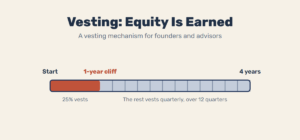
- When does the right vest?
- What happens if the advisor stops working with the company?
- What are the tax implications?
What is a Cap Table, and why can it become a problem?
The Cap Table is the company’s ownership map. It shows who holds shares, who received options, what the option pool is, and which rights may turn into shares in the future.
| Recipient | Percent of the company |
|---|---|
| Business advisor | 1.5% |
| Technology advisor | 1% |
| Mentor | 0.5% |
| Marketing advisor | 1.5% |
| Investor connector | 1% |
| Strategic partner | 2% |
| Total | 7.5% |
The company gave away 7.5% before it even reached its first investor. The problem is not only the percentages. You need to know whether all the grants were approved, whether agreements were signed, whether there are vesting terms, whether some rights have already vested, whether there are commitments that do not appear in the table, and whether the percentages were calculated after the option pool.
What will an investor think of your equity split?
Investors do not look only at how many percent remain with the founders. They also look at the quality of the capital structure. A company with vague commitments, unsettled holdings and undocumented grants may have to clean up the mess before an investment.
The Cap Table is not just an accounting document. It reflects the quality of the founders’ decision-making. You can read about what an investor tests in a meeting in the post What Investors Really Test in a Meeting.
An option pool is usually set in a funding round, and sometimes it dilutes the founders first. It is worth understanding this before you sign the investment terms, not after.
Which five questions should you ask before giving a percentage?
- Does the advisor bring a capability we do not have right now?
- Do they commit to defined time and involvement?
- Can their contribution be measured?
- Are they likely to create significant value over time?
- Could we pay them in cash instead of giving up ownership of the company?
What is the right way to distribute equity?
- Set an allocation policy.
- Define an option pool.
- Distinguish between employees, founders, advisors and mentors.
- Price the contribution, not only the personal connection.
- Use vesting mechanisms.
- Maintain an up-to-date Cap Table.
- Check the legal and tax aspects in advance.
The bottom line: Do not hand out pieces of the company today just because you have no money to pay. Think about how much those percentages may be worth on the day the company succeeds. Equity is the currency of your future, so manage it accordingly.
Decided to give equity? Here is how to do it right: vesting, option agreements and tax
Frequently Asked Questions
How much equity should you give an advisor?
There is no single percentage that fits every company. It depends on the company’s stage, the level of involvement, experience, the length of the engagement, and whether the advisor also receives cash. A one-off consultation usually does not justify equity.
What is the difference between shares and options?
Shares make the recipient a shareholder. Options are a right to buy shares in the future at an exercise price set in advance, subject to conditions.
What is a Cap Table?
The company’s ownership map: who holds shares, who received options, what the option pool is, and which rights may turn into shares in the future.
Can you pay an advisor in cash instead of equity?
Yes, and it is a question worth asking before any grant. Equity is part of your ownership and future value, so it is worth considering cash first.
Important to know: This article is based on my personal experience. It is not a commitment to legal accuracy, and it is not legal or tax advice. Anything related to law, taxation and agreements should be checked with professionals, a lawyer and an accountant who specialize in equity compensation, before you make a decision or promise anything to another person. Every grant requires a case-by-case review of the company structure, the terms of engagement and the applicable law.