In short: A business mentor is someone who has already walked the road you’re on now, and helps you make better decisions – without making them for you. To choose well, check three things: real experience with your kind of challenge, someone who asks more than they advise, and chemistry and trust between you. You can check all of these in the very first conversation.
What is a business mentor – and how is it different from a consultant or a coach?
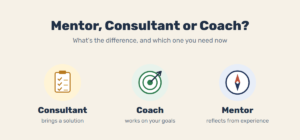
These three roles get mixed up a lot, but they are different:
- A consultant brings a solution to a defined problem, and sometimes implements it too. They are an expert in a specific field – marketing, finance, operations – and usually work on a project basis.
- A coach works on your goals, habits and thinking. They don’t have to know your field, and usually aren’t supposed to give advice.
- A mentor has already walked the road. They know the decisions from the inside – fundraising, building a team, a crisis, working with a board – and so they know how to ask the right questions and reflect back what’s hard to see from the inside.
The key difference: a consultant answers. A mentor asks. I wrote more about this in the post on the questions a mentor asks.
When do you need a mentor?
There are stages in a company’s life when a mentor can make the biggest difference:
- At the start – when you need to validate the market, set a price, build a financial plan and prepare to raise.
- After raising – when the company grows, a management team forms, and suddenly there’s a board and investors.
- In a crisis – cutbacks, layoffs, a change of direction, a dispute between founders.
- When something isn’t moving – the plan is clear, but the decision keeps getting postponed. Often the problem here isn’t a lack of knowledge, but a fear or a recurring pattern.
Five things to check before you choose
1. Experience with your challenge – not just “experience”.
A mentor who built a software company doesn’t necessarily understand a hardware startup. A mentor who has been a CEO knows the loneliness of the role. Ask yourself: have they been through what I’m going through now?
2. They ask more than they advise.
In the first conversation, notice who talks more. A good mentor will ask a lot before saying anything. If they come with ready-made answers before they understand the situation – that should raise a red flag.
3. They tell you uncomfortable things too.
A mentor who only compliments you doesn’t help. You need someone who will say “I’m not sure that’s right” – and explain why.
4. Chemistry and trust.
You’ll need to tell them things you don’t tell your board, your team, and sometimes not even your co-founder. Without trust, that won’t happen.
5. Availability and commitment.
How many sessions, how often, and what happens between sessions – when something is on fire on a Tuesday evening?
What to ask in the first conversation
- “Tell me about a similar situation you went through – and what you’d do differently today.”
- “What does working with you look like – how many sessions, and what happens in between?”
- “When would you tell me you’re not the right person for me?”
- “What do you expect from me in the process?”
- “Who have you worked with recently, and can I talk to one of them?”
And one question for yourself, after the conversation: did I come out of it with a new thought – or just a good feeling?
Warning signs
- Promises results – “In three months you’ll raise.” Nobody can promise that.
- Talks mostly about themselves – war stories are nice, but the sessions are supposed to be about you.
- One solution for every problem – the same method and the same template, regardless of your situation.
- Manages instead of you – a mentor reflects the situation back to you and helps you decide. They don’t make the decisions for you.
- No real field experience – only theory, courses and degrees.
How much does it cost?
There’s no single price. There are two common models:
- Per session or per process – suits a defined challenge, such as preparing to raise or building a management team.
- Ongoing monthly mentoring – suits CEOs and leadership teams who want someone by their side over time.
The price depends on the mentor’s experience, the scope of the work and the size of the company. What matters more than the price: knowing in advance what the process includes, and what is supposed to change by the end of it.
How I work
I mentor founders, CEOs and leadership teams, and I have also mentored CEOs of nonprofits. Before that, I founded Highcon and led it as CEO for about a decade, and worked at Indigo and HP as a product manager. The process starts with an intro call, with no commitment, and runs for at least 10 sessions – hybrid, as you prefer. The price is set in the intro call, according to the scope of the mentoring.
There are two tracks:
- Early Stage Mentoring – need and market, pricing, financial plan, MVP and fundraising prep.
- Executive Mentoring – for companies that have already raised, when the challenge is to lead and work as a team.
And if you’d like to see what such a process looks like from the inside, I wrote about it in What a Mentor Really Does.
Frequently asked questions
What’s the difference between a business mentor and a business consultant?
A consultant brings a solution to a defined problem, and sometimes implements it. A mentor has already walked the road, and helps you make better decisions – without making them for you.
How long does mentoring last?
It depends on the challenge. A focused process, such as preparing to raise, can take a few months. Mentoring a CEO or a leadership team can last a year or more.
Do I need a mentor who knows my exact field?
Not necessarily your field, but your kind of challenge. A mentor who built and led a company will understand a CEO’s dilemmas, even if the product is different.
How do you know mentoring is working?
When you make decisions you’d been putting off, spot blind spots you didn’t see before, and reach the milestones you set at the start.
The bottom line: A good mentor isn’t measured by how much advice they give, but by how much better you make decisions after meeting with them. Choose someone who has been through what you’re going through, who asks before they answer, and whom you trust enough to tell the truth.
Want to see if we’re a good fit? Book an intro call.